5th Grader Quiz: Are You Smart
KDR GamesTrivia
4.5106.00 Reviews
- Version
- 11.0.4
- Installs
- 100.00K
- Age Rating
- Everyone
Screenshots
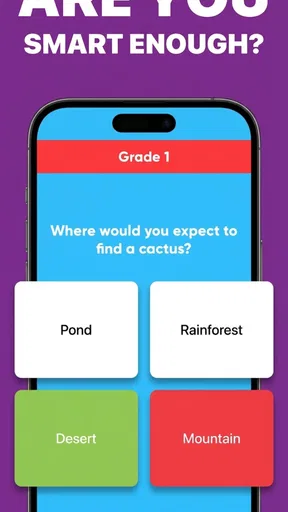
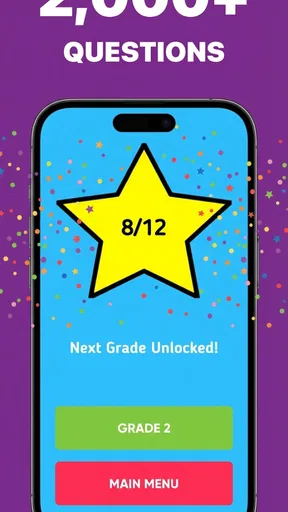
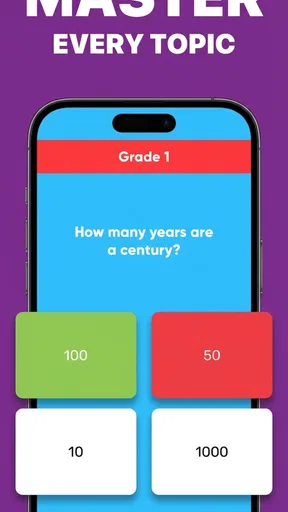
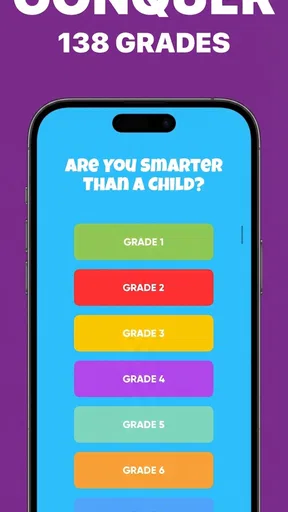
Our Review of 5th Grader Quiz: Are You Smart
 Analysis by Appyee
I approached 5th Grader Quiz: Are You Smart as a quick general-knowledge game rather than a serious study tool, and that distinction matters. It is a free trivia title from KDR Games built around a simple challenge: answer questions that are meant to feel like elementary-school knowledge and see how confident you really are. That sounds easy until a familiar topic is phrased in an unexpected way or a basic fact slips your mind.
After spending time with it, I found the appeal comes from its low barrier to entry. There is no complicated setup to learn and no special subject knowledge required before starting. You can use it for a short solo session, pass the phone around during a casual gathering, or open it when you want something more active than scrolling but less demanding than a full strategy game.
The game is listed as free, with optional in-app purchases priced from $1.99 to $2.99 per item. That makes the initial decision straightforward: you can try the core experience without paying. The important question is not whether it is expensive to start, but whether the available play experience gives you enough reason to keep returning.
How the quiz feels in everyday use
The central idea is easy to understand. You receive general-knowledge questions and choose the answer you believe is correct. The “fifth grader” framing creates a useful tension: the questions are supposed to be approachable, but the game also exposes how much we forget when we stop using basic facts.
I like this format because it avoids the intimidation that can come with specialist trivia games. You do not need to be a history enthusiast, a science student, or a sports expert to participate. A question may appeal to one person’s strengths and then immediately move into a subject where another player has the advantage. That makes it a better choice for mixed groups than a narrowly themed quiz.
It also works well as a short-break game. If I only have a few minutes, a trivia round feels more satisfying than starting a large game that expects a long session. The format encourages quick decisions, so it suits moments such as waiting for an appointment, taking a break between tasks, or sharing a few questions with a friend after dinner.
One practical way to get more from it is to treat wrong answers as prompts for conversation rather than simply failures. When playing with someone else, pause briefly after an uncertain question and explain why each person chose an answer. That turns a basic quiz into a lightweight social activity and helps reveal whether the difficulty came from not knowing the fact or from misreading the wording.
Another useful approach is to avoid judging your ability from one short session. Trivia performance changes with concentration, familiarity, and even the order of subjects. I would play several brief sessions before deciding whether the game feels too easy or appropriately challenging. A result from a distracted moment says as much about your attention as it does about your knowledge.
A friendly entry point into general knowledge
The strongest part of the concept is its accessibility. Many trivia games are designed around impressive scores, deep specialist knowledge, or competition with a large online audience. This one is more comfortable for people who want a relaxed test without preparing beforehand.
That makes it suitable for families, casual players, and anyone who enjoys the feeling of being challenged without needing to master a complicated interface. The Everyone content rating also supports that broad positioning. Parents or guardians looking for a simple knowledge-based game can consider it for a general audience, while adults may enjoy it precisely because apparently simple questions can be surprisingly difficult.
Still, accessible does not mean universally engaging. If you prefer games with a strong story, character progression, visual discovery, or strategic decision-making, the quiz format may feel thin. Its pleasure comes from recognition, recall, and the small emotional swing between confidence and surprise. Players who need a richer game world will probably find a dedicated puzzle adventure or strategy title more rewarding.
What the free price means in practice
The free entry point is the clearest value advantage. You can decide whether the question style suits you before spending anything, which is exactly what I want from a casual trivia game. The optional purchases sit between $1.99 and $2.99 per item, so anyone considering them should first establish whether the unpaid experience already provides enough entertainment.
I would not treat the purchase options as an automatic reason to pay. Their value depends on what you personally want from the game and how often you expect to use it. A person opening the quiz occasionally may be perfectly satisfied with free access. Someone who keeps returning for short daily sessions may view an optional purchase differently, but should still compare the benefit against the fact that the game’s basic appeal remains a question-and-answer loop.
This is also where expectations matter. Paying does not transform a simple trivia game into a comprehensive learning platform. If your goal is structured revision, progress tracking for a school subject, or a dependable reference for studying, an educational app designed specifically for that purpose would be a better use of money. Here, the value is primarily recreational, with incidental learning as a welcome side effect.
I appreciate that the free starting point makes experimentation easy, but I would approach purchases slowly. Play enough to learn whether the question mix holds your attention, and only then decide whether an optional item adds meaningful convenience or enjoyment for your routine. That is a more sensible test than buying immediately because the price looks small.
Where the game earns its place
The game’s value is strongest in situations where simplicity is an advantage. It can fill a few spare minutes without demanding a long commitment, and it gives two people an easy subject to discuss. It is also a useful choice for a group with uneven gaming experience because nobody has to learn controls, memorize a complicated ruleset, or understand a fictional setting.
There is a subtle social benefit too. A general-knowledge question can create a conversation that would not otherwise happen. One player may know the answer, another may remember a related fact, and a third may explain why an apparently obvious choice is wrong. That makes the game more flexible than a purely score-driven activity.
For solo use, I found it most enjoyable when I focused on patterns in my mistakes. If I repeatedly miss questions from one area, that tells me more than a single overall result. You can use those misses to guide later reading or simply accept them as the amusing part of the challenge. The game does not need to become homework to provide that small moment of reflection.
It is also worth using the quiz as a warm-up rather than the main event. Before a family game night, a few questions can get everyone talking. During a break from work or study, it can provide a mental change of pace. In both cases, its modest scope is helpful: you can stop quickly without feeling that you abandoned a major campaign.
The trade-offs behind the simple design
The same simplicity that makes the title approachable can limit its long-term depth. A trivia game depends heavily on whether its questions continue to feel varied and worthwhile to the individual player. If you already know a large portion of the material, the experience may become more about speed and repetition than discovery. If the questions regularly fall outside your interests, the general format may not be enough to keep you engaged.
There is also a difference between being “smart” and being familiar with the subjects chosen by a quiz. A wrong answer does not necessarily show weak reasoning, and a correct answer does not prove broad knowledge. I would avoid treating the title as a serious measurement of intelligence. It is better understood as a playful sample of general facts.
Players who want detailed explanations may also need to moderate their expectations. The core attraction is answering, not taking a full lesson after every choice. For genuine learning, I would pair the game with reliable reading or a dedicated educational resource. The quiz can identify gaps in memory, but it should not be the only source used to fill them.
Another trade-off concerns replay value. A trivia title can remain enjoyable for a long time when the question pool feels fresh, but its appeal naturally depends on how often you encounter material that surprises you. If you are looking for an endless progression system, elaborate unlocks, or a competitive ladder, this is probably not the right category of game. A more feature-rich alternative would better serve that need.
Performance, compatibility, and practical details
The current version is 11.0.4, and the game requires Android 7.0 or later. That makes the operating-system requirement an important check before installation, especially if you are using an older phone or tablet. On a compatible device, the lightweight trivia concept should be easier to fit into everyday use than a large, graphics-heavy game, although I would still keep enough storage and system resources available for normal app updates.
The title has reached over 100 thousand installs and holds a 4.5 average from around 1.4 thousand ratings, with 106 written reviews. Those figures suggest that it has found a real audience, but they should be read as a starting signal rather than a guarantee that every player will enjoy the same question style. Ratings are useful for confirming that the basic concept works for many people; your own tolerance for repetition and your preferred difficulty remain more important.
KDR Games keeps the product focused on trivia rather than presenting it as a broad educational suite. That focus is a strength when you want immediate play, but it is also the reason I would not choose it for formal learning. The game belongs on the entertainment side of the knowledge spectrum, even when a question teaches you something along the way.
Who should install it, and who should skip it
I would recommend trying it if you enjoy general-knowledge quizzes, want a free game for short sessions, or need a simple activity that works for people with different interests. It is especially suitable for casual players who do not want to spend time learning controls or managing a complex progression system.
It can also suit families and friends who like comparing answers without turning the evening into a serious competition. To make that work, I would take turns reading questions aloud, let everyone commit to an answer before discussing it, and use incorrect responses as conversation starters. That approach makes the game feel less like a private score chase and more like a shared challenge.
I would skip it if you want a subject-specific study aid, deep explanations, a story-driven experience, or a strong sense of character and world-building. I would also look elsewhere if you dislike being tested on basic facts or become frustrated when a quiz’s chosen topics do not match your interests. A specialized geography, language, science, or history app would be more appropriate for focused improvement.
For competitive players, the decision depends on what kind of competition you enjoy. If you like friendly arguments and comparing knowledge, it can work. If you need live opponents, detailed rankings, or a large multiplayer structure, a dedicated competitive trivia platform is likely to offer a better fit. The attraction here is convenience and broad accessibility, not an elaborate tournament environment.
My recommendation after weighing the value
My verdict is to try the free version first. The cost of entry is low because the game is free, and the format is immediately understandable. Give it several short sessions rather than judging it after one lucky or frustrating run. Notice whether the questions make you curious, whether you enjoy discussing answers, and whether the general subject mix keeps you interested.
I would consider an optional purchase only after the unpaid experience has already become part of your routine. At $1.99 to $2.99 per item, the price is modest in isolation, but value still depends on actual use. A small purchase is worthwhile only when it improves an experience you already enjoy; it is not a substitute for depth the game was never designed to provide.
Overall, this is a straightforward trivia game with a welcoming premise and a useful place in short, casual play. Its best qualities are the free starting point, broad accessibility, and ability to create quick conversations around everyday knowledge. Its limits are equally clear: it is not a full learning course, an expansive game world, or an advanced competitive platform.
My honest advice is simple: install it when you want an approachable general-knowledge challenge, but skip the purchase unless the free experience proves that you will return regularly. For a relaxed quiz on Android, it delivers a clean reason to play. For anything more ambitious, I would choose a more specialized alternative.
Verdict
Strengths of 5th Grader Quiz: Are You Smart
- Covers core fifth-grade subjects in short, easy-to-complete rounds.
- Simple interface makes it accessible for younger players.
- Quick questions are suitable for casual play or study breaks.
- Can help children identify topics they need to review.
- Quiz format encourages friendly competition and replayability.
Limitations of 5th Grader Quiz: Are You Smart
- Some questions may feel too easy for advanced fifth graders.
- Repeated questions can reduce variety during longer sessions.
- Educational depth may be limited compared with dedicated study apps.
- Younger children may need help reading certain questions.
- Ads or in-app prompts may interrupt the quiz experience.
Other Releases by KDR Games
View All


Similar Picks in This Category
View All
Millionaire 2026 Quiz & Trivia
Quiz & Trivia Games by Submarine Apps4.5

Brain Test 2: Tricky Stories
Unico Studio4.7

Trivia Crack: Brain Quiz Games
etermax4.4

QuizzLand. Quiz & Trivia game
Quiz & Trivia Games by Mno Go Apps4.8

Brain Test: Tricky Puzzles
Unico Studio4.7

Logo Quiz
bubble quiz games4.5
Frequently Asked Questions
What is 5th Grader Quiz: Are You Smart?
5th Grader Quiz: Are You Smart is a trivia and knowledge game built around questions that resemble subjects commonly taught in elementary school. It tests areas such as mathematics, science, history, geography, language, and general knowledge. The questions may look simple at first, but some are designed to challenge memory, attention, and basic reasoning rather than just academic knowledge.
Is 5th Grader Quiz: Are You Smart suitable for children?
The game can be suitable for children who are comfortable reading and answering school-related questions, as well as for teenagers and adults looking for a light challenge. However, parents should review the app’s current age rating, advertising policy, and privacy information before installation. Difficulty and content can vary, so younger children may need help understanding certain questions or reading instructions.
Does the game require an internet connection to play?
Whether an internet connection is required may depend on the version installed and the feature being used. Basic quiz rounds may work offline if the necessary content is already included, while advertisements, score sharing, updates, or other online services can require connectivity. It is best to check the app-store listing and test the game after installation before relying on offline access.
Is 5th Grader Quiz: Are You Smart free to download and play?
The app may be available as a free download, but free access does not always mean that every feature is completely free. Many quiz games support themselves through advertising and may offer optional in-app purchases, such as removing ads, unlocking content, or receiving additional hints. Before downloading, review the store page for current pricing and purchase details.
What can players expect from the questions and scoring system?
Players can generally expect short, multiple-choice questions covering familiar school topics and general knowledge. Correct answers may increase a score, unlock progress, or help the player advance through a quiz, while incorrect answers can reduce opportunities or end a round. The exact scoring rules may differ between versions, so pay attention to the instructions shown before each challenge.
Play our best games!


